

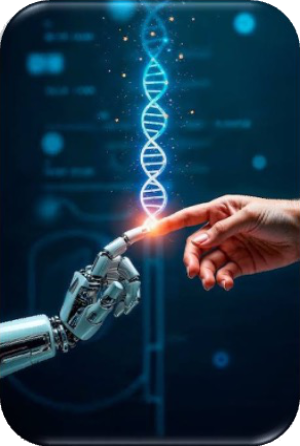
If knowledge had limits, man would be perpetuated without evolving…
Orpheus*
—
Science is not static, for it is ever evolving in its inquiry into the “how” of the natural and material world that surrounds us, and of which we ourselves form a part. Since, then, it is not static, but continually evolving, it cannot be absolute in its findings, which tomorrow will be modified by that very evolution.
The evolution of the spirit opened the way to science and technology, that the life of man might be improved. And indeed, in certain fields this improvement has come to pass. Undeniable are the goods it offers; yet man’s willful blindness to its harmful attainments is a peculiar thing.
Scientific progress, especially in recent years, has swept up most of mankind. The result is that all interest turns obsessively about science, and we find ourselves in a race for new discoveries. Every sphere of human activity is now dictated by the new technologies of another intelligence, heedless of the moral values that once sustained humanity.
Persons of worth and many gifts, scientists or otherwise, find themselves trapped within a new “reality,” wherein man loses man, and loses his humanity.
The “how” is not enough, if the “why” is not also established — by that same Science which denies the existence of the Unknown Power that governs all things.
Has science, in the end, become the new God?
Knowledge, of course, has no bounds. But it is knowledge indeed for man to perceive that one-sided evolution, unaccompanied by the cultivation of his inner self, advances rapidly to his own detriment.
* From our Publication “Concise Interpretation of Greek Mythology” (Speech #7 ‘The Goddess Athena’)